




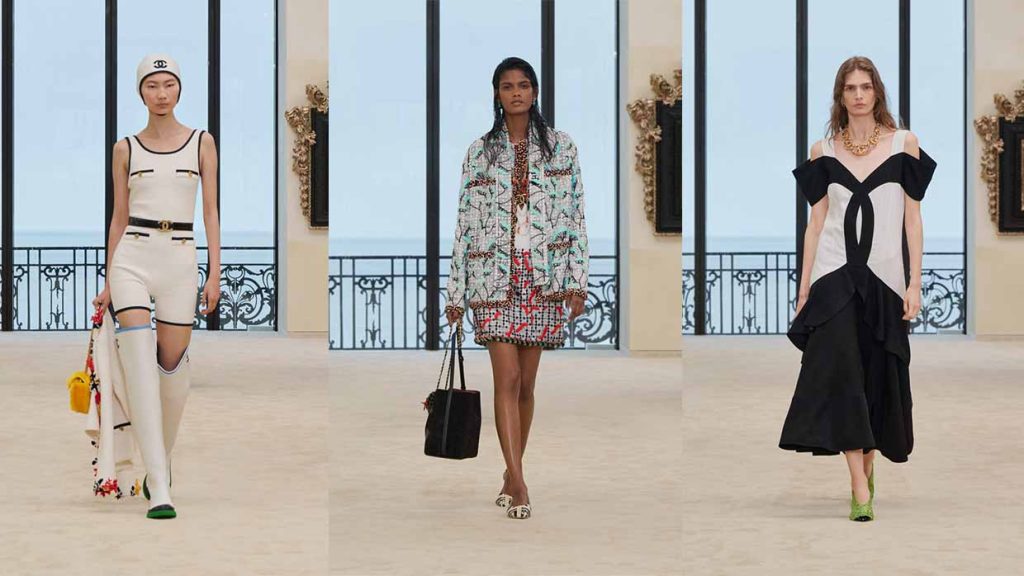
Far from the polished confines of Parisian salons, a different rhythm emerges – one shaped by salt air, sunlit horizons, and the perpetual motion of the sea. In Biarritz, CHANEL returns not merely to a place, but to a philosophy. It is here that Gabrielle Chanel once redefined the language of fashion, aligning the eternal cadence of nature with the urgency of modern life. For the Cruise 2026/27 collection, Matthieu Blazy revisits this origin story, conjuring a world where freedom of movement, multiplicity of identity, and the poetry of practicality converge in a quietly radical vision.
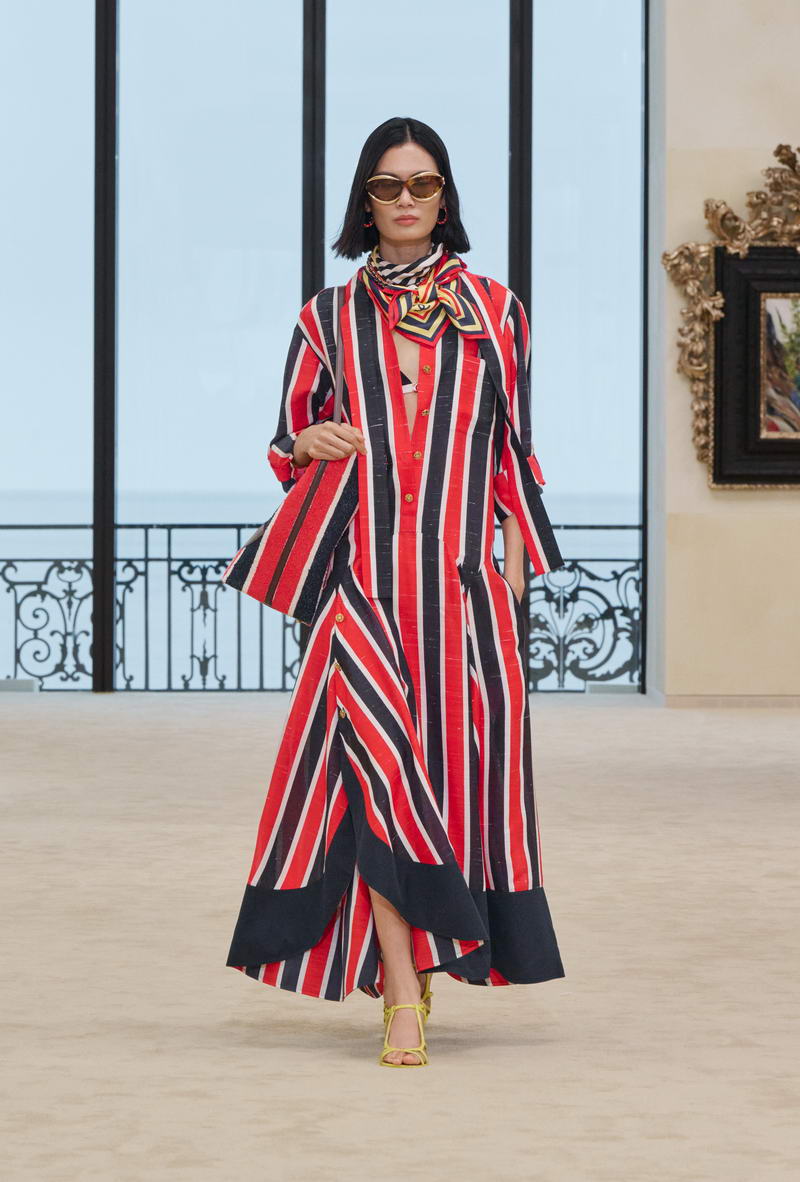
Biarritz, as Blazy evokes it, is not simply a destination but a living stage – one where artists, workers, aristocrats, and sailors coexist without hierarchy. This spirit of shared presence, where function and fiction blur, becomes the foundation of the collection. It is a place where clothing sheds its rigid codes, where the salon slips seamlessly into the beach, and where elegance is no longer confined but set free in motion.
At the heart of this narrative lies Gabrielle Chanel’s enduring liberation of the body. Rejecting the constraints of salon-bound existence, she turned to the outdoors – the sea, the wind, the sun – as her collaborators. Jersey and sportswear became instruments of emancipation, offering women not only comfort but autonomy. Blazy channels this ethos with a collection that feels perpetually in flux, guided by the simple, sensual act of dressing and undressing. Bathing suits emerge as essential anchors, while fluttering silk foulards, rustling raffia skirts, and washed cotton canvas suits echo the rhythm of a life lived between land and sea.
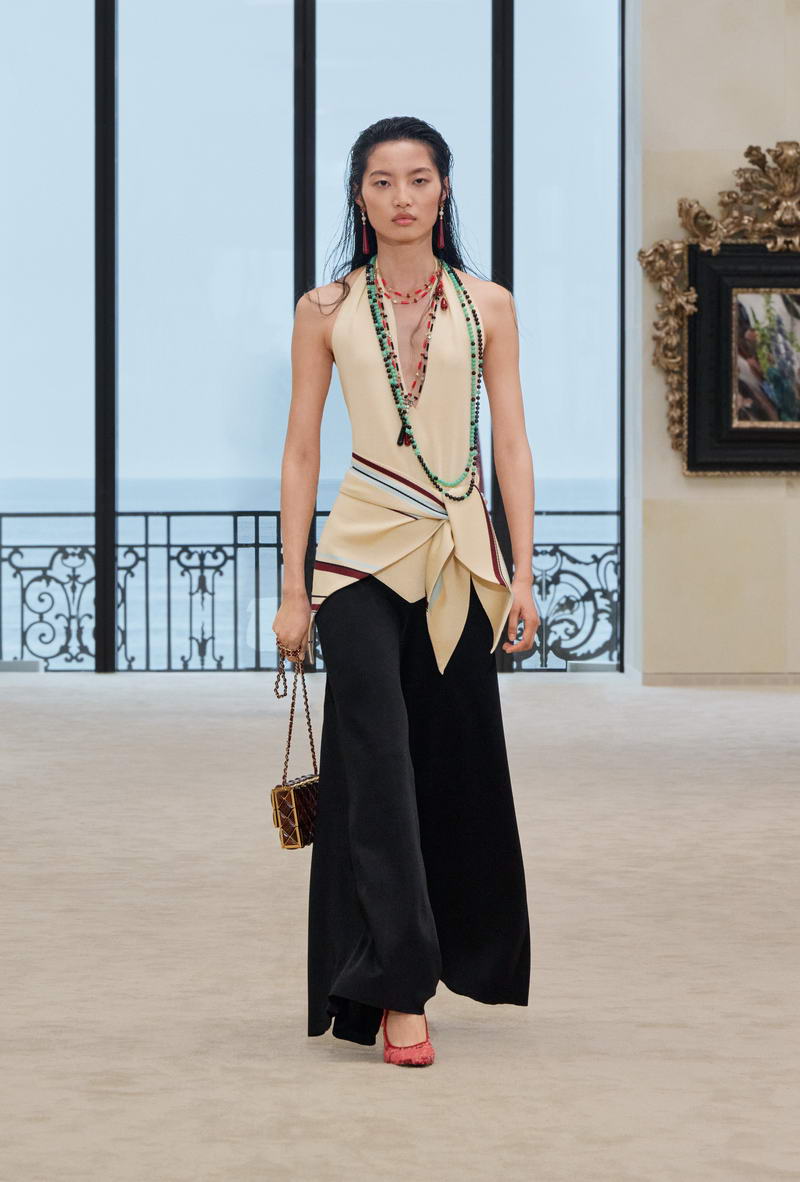
The collection unfolds as a study in contrasts that ultimately dissolve: French workwear meets leisurewear, rigor dances with effervescence, and uniforms of sailors transform into the flourish of gowns. The Basque stripe threads its way throughout, a visual line that binds these disparate elements into a cohesive whole. Here, hierarchy is not merely challenged – it is rendered obsolete.
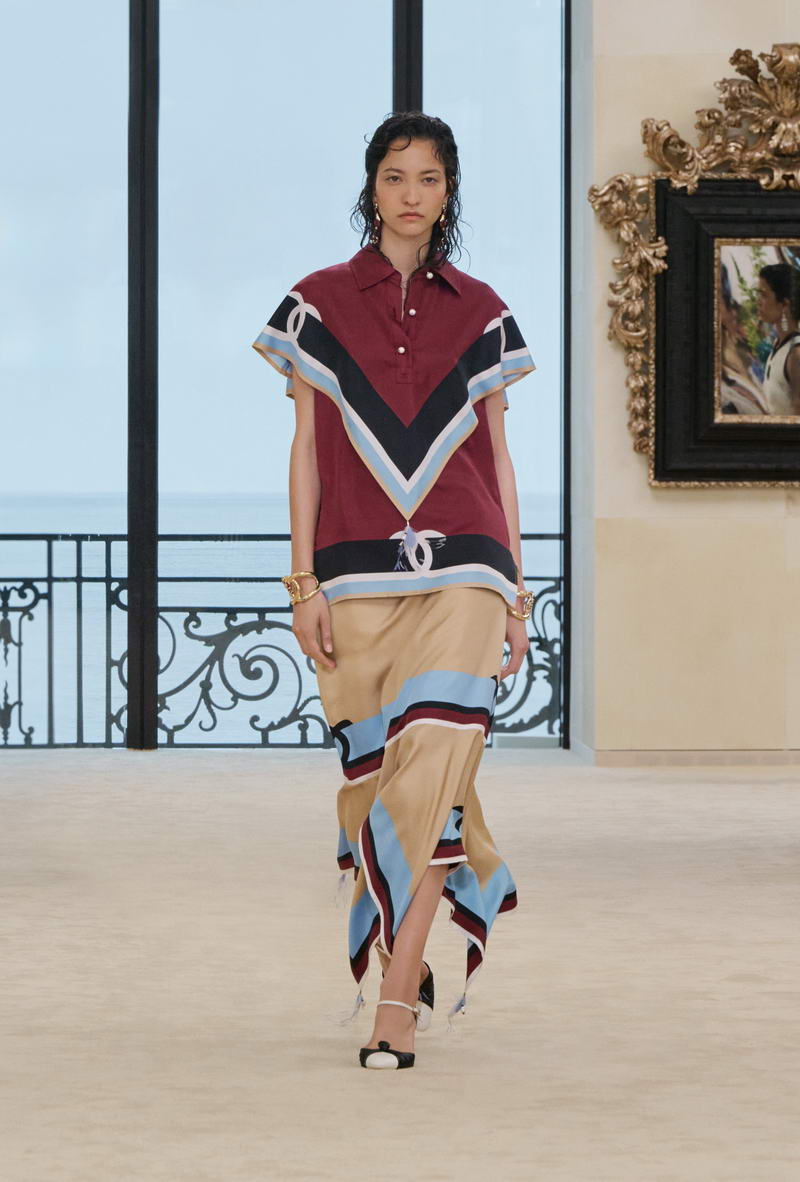
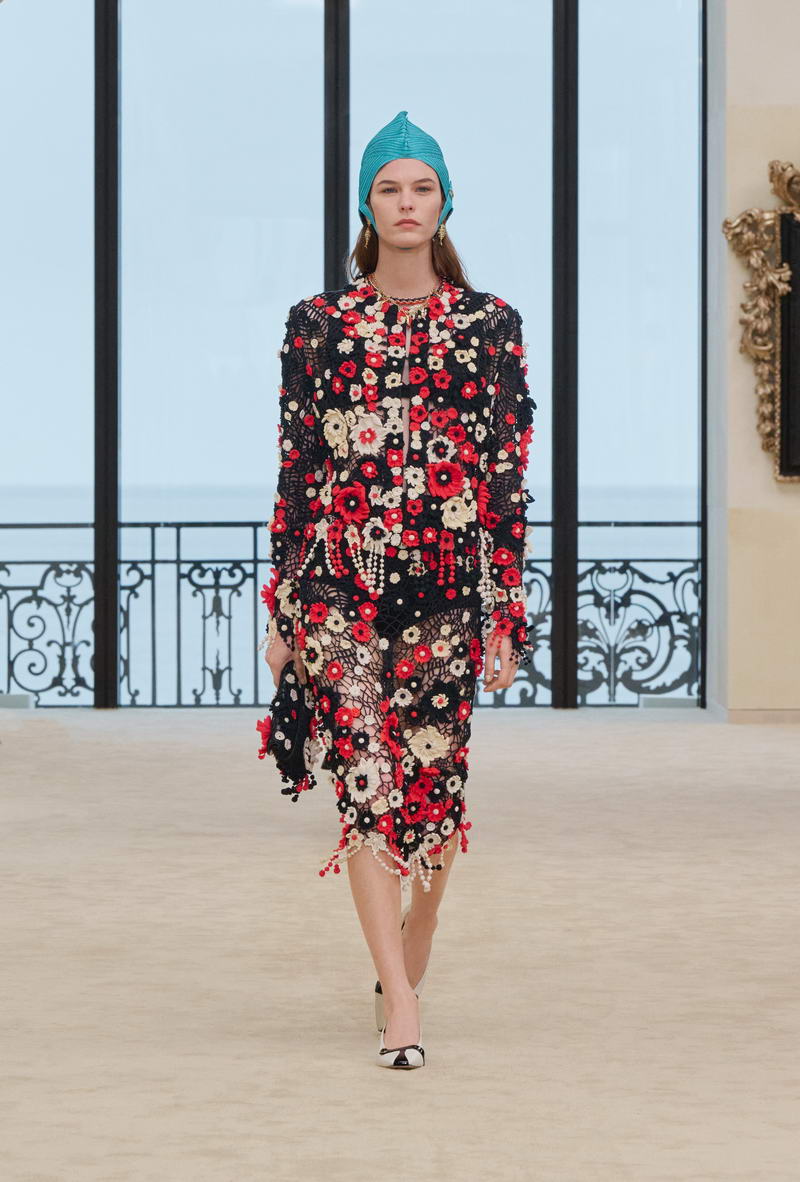
Materiality plays a central role in this sensorial exploration. Fabrics are chosen not only for their beauty but for their tactile resonance, mirroring the abundance of the natural world that surrounds Biarritz. Fluid silks ripple like water, springy tweeds carry a buoyant energy, and compact flocks offer structure without rigidity. Soft beaded knits and shimmering fish-scale paillettes evoke an aquatic dreamscape, where reality and imagination merge in a new CHANEL folklore – one that moves effortlessly between the grounded and the fantastical.
Within this fluid architecture, the double C motif emerges not as a symbol of branding, but as an elemental form embedded within the garments themselves. Its sinuous contours recall Gabrielle Chanel’s original manifesto – her insistence on clarity, precision, and self-definition through dress. Introduced radically in the 1930s, it remains a signature that invites interpretation. In this collection, it becomes a framework upon which the wearer inscribes her own narrative, reinforcing the idea that clothing is not prescriptive but participatory.
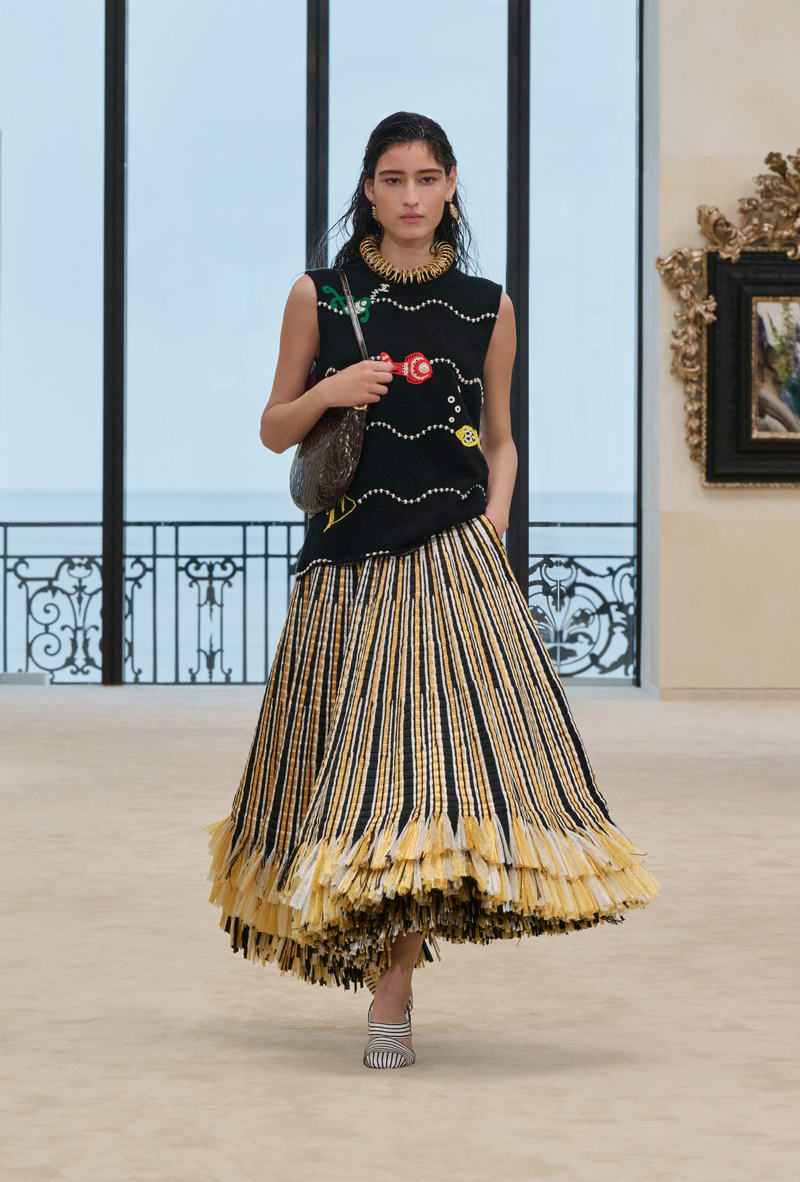
Accessories extend this sense of journey, traversing the spectrum between utility and whimsy. A small valise handbag suggests departure, while a capacious holdall anticipates arrival. Waterproof flap bags coexist with oversized striped beach paniers, and even a pala carrier finds its place within this eclectic ensemble. Footwear mirrors this duality: elegant Art Deco heels stand alongside barefoot “heel caps,” offering a freedom that transcends setting. Jewellery, too, reflects the architectural elegance of Biarritz, infused with an aquatic sensibility – shell earrings cling to the ear, and the CHANEL pearl finds a natural, almost spiritual resonance.
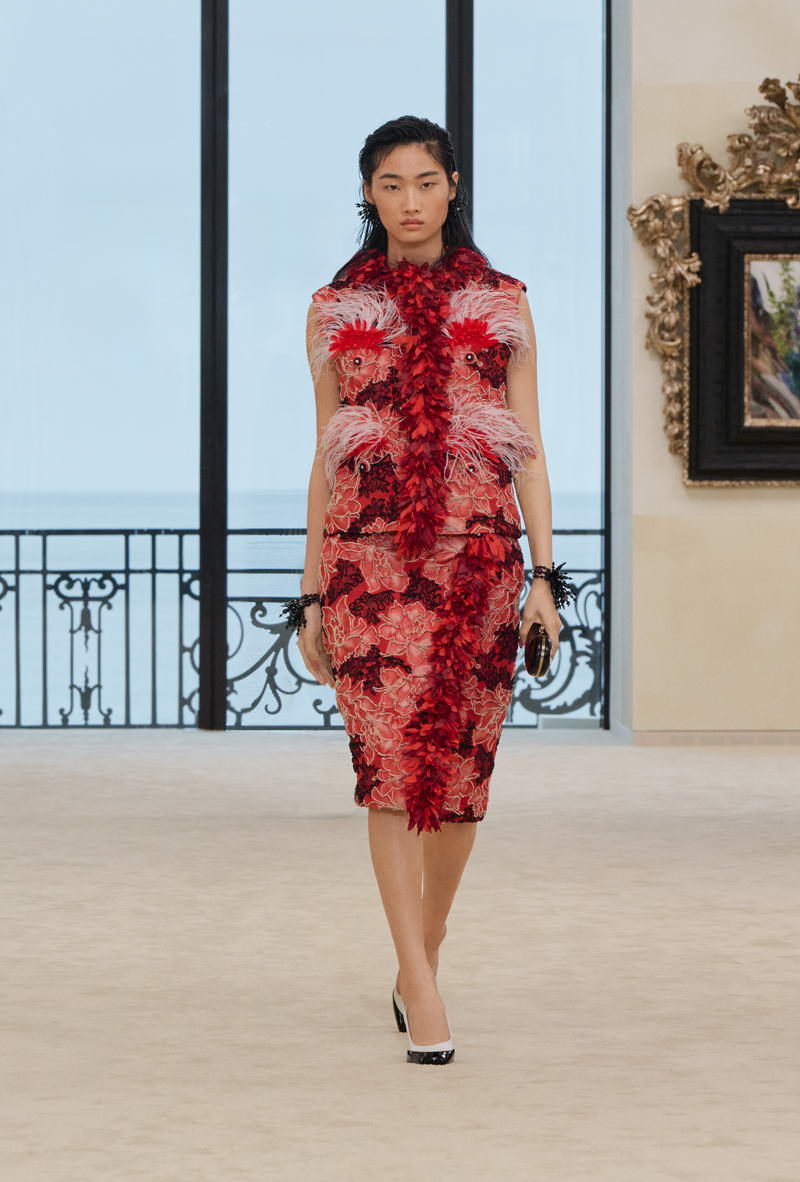
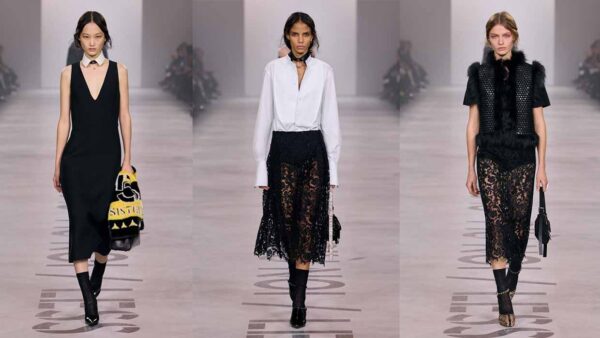
Central to the collection’s narrative is the enduring power of the black dress. Introduced by Gabrielle Chanel in 1926, it was never intended as a mere garment, but as a declaration. Purposeful and precise, its simplicity masked a profound disruption of fashion’s established order. At a time when haute couture reveled in excess, the black dress proposed clarity. It drew from the attire of working women – servants, shopgirls, and convent sisters – and elevated it, challenging societal hierarchies with quiet defiance.
Blazy reintroduces this iconic piece as the opening look of the collection, returning to its original archival sketch. Notably, the bow absent from the 1926 illustration reappears here as a clutch bag, a subtle yet meaningful transformation that bridges past and present. The black dress, once revolutionary, now stands as an archetype – its significance not diminished but deepened by time. It is a garment that demands interpretation, inviting each wearer to define its meaning anew.
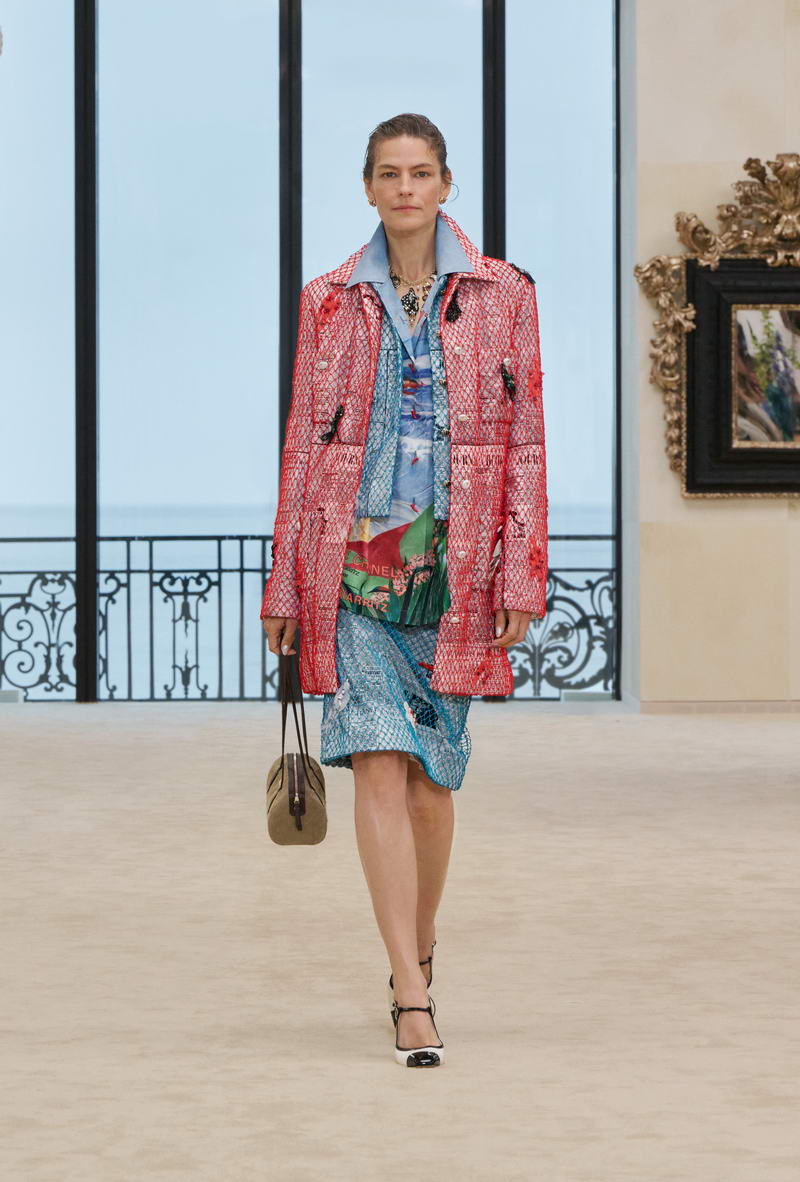
This ethos extends to the broader vocabulary of French workwear referenced throughout the collection. From the sailor’s marinière to the humble bleu de travail, these garments carry both functional integrity and a rebellious undercurrent. Their presence within the CHANEL lexicon affirms their evolution from utilitarian staples to cultural icons, reinforcing the collection’s commitment to dissolving boundaries between the ordinary and the extraordinary.
“There is no beauty without freedom of the body,” Gabrielle Chanel once declared. In Biarritz, that freedom takes on a tangible form – woven into fabrics, embedded in silhouettes, and carried through every movement. The Cruise 2026/27 collection does not merely revisit history; it reanimates it, offering a vision of fashion that is at once grounded and transcendent.
In this space where the salon meets the sea, CHANEL proposes a new way of being – one defined not by constraint, but by possibility.